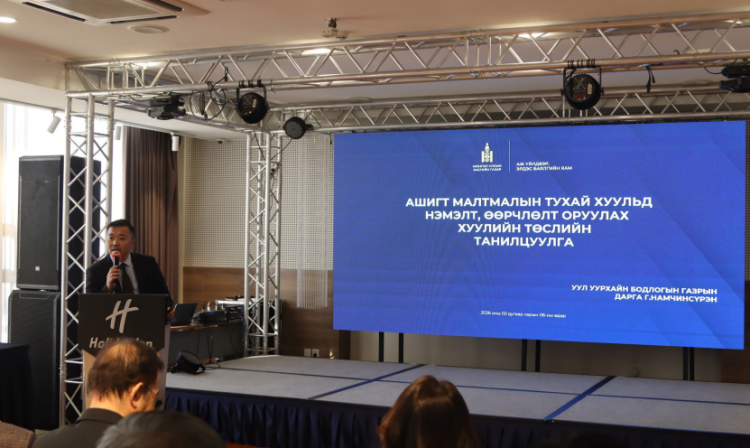


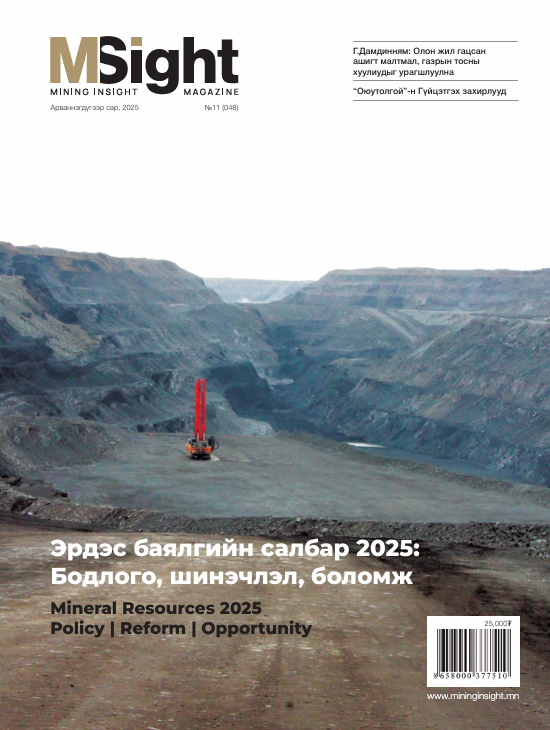
 Awave of legal reform is beginning to sweep through Mongolia’s extractive sector. From amendments and revised versions of existing laws to the drafting of entirely new legislation, this reform agenda signals a fundamental reassessment of the sector’s governance framework and a deliberate effort to chart its future direction. It is this pivotal moment of transition to which we dedicate our November issue. Since assuming office six months ago, the Minister of Industry and Mineral Resources, G. Damdinnyam, has set an ambitious target: to reform five key laws. The scope alone illustrates the scale of change ahead. Two of these are entirely new laws, one is a full revision, and two involve substantial amendments.
 The government is preparing amendments to the Law on Minerals and the Law on Petroleum Products, a complete overhaul of the Petroleum Law, and for the first time a standalone legal framework for the heavy industry sector. The Law on Ensuring the Supply of Strategic Commodities, approved under fast-track procedures, already stands as the first tangible outcome of this reform effort. While amendments to the Minerals Law are ready for submission, the remaining drafts are still under development. The core direction of the Minerals Law reform is clear: ensuring a fairer distribution of mineral wealth, strengthening meaningful local participation, and revitalizing the exploration environment. Adjustments to the royalty regime for copper, reopening exploration through an application-based system, and clarifying the governance of critical minerals have already attracted investor interest. In the petroleum sector, reforms aim to secure stable feedstock for Mongolia’s domestic refinery and to integrate extraction with downstream processing, an overdue but essential step for the national economy.
One of the most striking shifts is the decision to regulate both critical minerals and common minerals within the framework of the Minerals Law, while placing petroleum products under regulatory treatment comparable to hard minerals. This represents a significant departure from the long-standing practice of separating mineral resources into distinct legal regimes. It is a turning point that has the potential to reshape the broader logic of resource governance in Mongolia. The Minister’s interview in this issue provides deeper insight into the intent behind these policy shifts and their implications for the investment environment. Our coverage explores the rationale of these reforms and the opportunities they seek to unlock, while recognizing the lessons drawn from earlier attempts that fell short.
The future of Mongolia’s mining and petroleum sectors is inseparable from the stability of their legal environment. Earlier efforts to revise the Minerals Law, dating back to 2013, did not pass public and political scrutiny. Nonetheless, the lessons from those experiences now underpin the current reform agenda. Unlike previous initiatives that aimed at sweeping structural overhauls, the present approach focuses on resolving the most urgent and growth-constraining issues with clarity and practicality. Mistrust among investors, resistance from local communities, ambiguity surrounding the definition of strategic deposits, and sudden changes in the tax regime have all acted as barriers to progress. The central challenge of the ongoing reform is to untangle these accumulated obstacles. If the bottlenecks that have stalled new projects can be resolved, genuine progress is likely to follow. At the same time, a fairer distribution of mineral revenues for local development, a royalty mechanism that can rebuild investor confidence, and an updated definition of strategic deposits, if approved by Parliament, could provide the sector with new momentum. In this issue, we sought to include a diversity of perspectives on the proposed legal reforms, with particular attention to the role and responsibility of Parliament in shaping the sector’s future. The interview with the Senior Advisor to the Prime Minister also offers readers valuable insight into the government’s broader reform agenda and the development trajectory envisioned for the next five years.