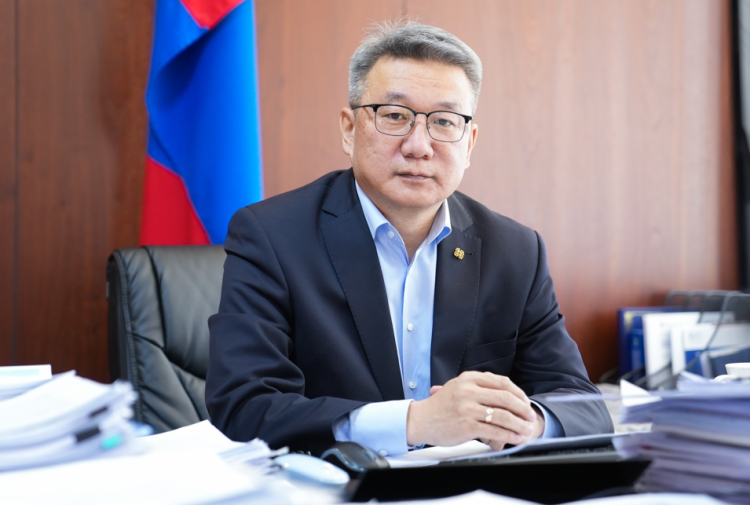


 Key long-awaited legal reforms in Mongolia’s extractive sector are now gaining momentum, Minister of Industry and Mineral Resources G. Damdinnyam said. Amendments to the Law on Minerals are ready to be submitted to the Government, while revisions to the petroleum legislation are actively being drafted. As these long-delayed legal changes move closer to clearing Parliament, Mining Insight’s N. Ariuntuya spoke with Minister Damdinnyam about the substance and direction of the reforms.
MORE ROYALTIES TO BE CHANNELLED TO MINING REGIONS
Amendments to the Law on Minerals and the Law on Petroleum Products are currently being prepared by dedicated working groups under the Ministry of Industry and Mineral Resources. At what stage are these processes now?
The draft amendments to the Law on Minerals are ready. They have been prepared through the Ministry’s Policy Council and consultations with experts, and have now been submitted to the Ministry of Finance and the Ministry of Justice and Home Affairs for approval of the policy concept. Our plan is to submit the draft to the Cabinet and table it in Parliament before the end of the year. As for the amendments to the Law on Petroleum Products, a working group is actively engaged in the process. Preparatory work is progressing well, and we are planning to submit this draft soon as well.
When we spoke with you in September, you outlined in some detail the directions of the proposed amendments to the Law on Minerals. Have there been any major changes since then? If so, what has changed and how?
There have been no major changes. To reiterate, first and foremost, the draft law embeds a policy to allocate a greater share of mineral royalty payments to local communities whose land has been used for mining. These are communities that have lived on and stewarded their land for generations, sometimes over centuries. In practical terms, the law introduces a mechanism for directly allocating royalties to the relevant province and soum, allowing local administrations to address their needs based on that allocation. This is intended to provide greater opportunities for communities that are directly affected by mining activities. Conversely, regions where no mining takes place would receive a comparatively smaller share of royalty revenues. The second major change is the inclusion of a plan to reduce the copper royalty rate. Third, the draft clarifies the regulatory framework for critical minerals. Fourth, it provides a much clearer definition of what constitutes a deposit of strategic importance. Once parliamentary consideration begins, we will ensure that public consultations are carried out alongside the legislative process.
Could you further clarify the revised definition of a “strategic deposit”?
Natural resources are endowments by nature. The royalty on these endowments, the mineral royalty should be paid by all mining companies, regardless of size. If this principle is fully applied, revenues from royalty and, consequently, funding for the Local Development Support Fund would effectively double. The policy intent is clear: this increased revenue will be used to support development in the regions where mining operations actually take place.
The initial draft Law on Critical Minerals was prepared by a working group led by MP B. Uyanga. Why is its content now being integrated into the amendments to the Minerals Law?
That is correct. The draft Law on Critical Minerals prepared by MP B. Uyanga and her colleagues aligns closely in substance and concept with a specific section of the Minerals Law. After consultations between the Government, the line ministry, and members of the working group, it was agreed to consolidate the two initiatives and incorporate the provisions into the amendments to the Minerals Law submitted by the Government. When the bill is tabled in Parliament, MP B. Uyanga and her colleagues will take the lead in advancing the amendments to the Minerals Law in their entirety.
Even though the draft contains only a limited number of articles, integrating it could trigger significant changes across related legislation. Would this not exceed the intended scope of the Minerals Law amendments?
No, it would not.
OIL TO BE REGULATED ON PAR WITH HARD MINERALS, WHILE PRODUCTION SHARING AGREEMENTS REMAIN
What is the main objective of the amendments to the Petroleum Law?
The primary aim of the amendments is to boost domestic exploration and increase production to a level sufficient to supply the oil refinery currently under construction in Altanshiree soum of Dornogovi province. In that sense, the changes are geared toward strengthening domestic fuel security. To achieve this, the legal framework is being adjusted to attract foreign investment while also remaining supportive of domestic investors Traditionally, Mongolia has applied international instruments such as Production Sharing Agreements (PSAs) in the petroleum sector, as is common worldwide. However, in recent years, oil has increasingly been treated, as a natural resource, under a regulatory approach similar to that applied to hard minerals. This shift is intended to improve the overall investment climate. Oil is a capital-intensive sector that requires several times more investment than conventional mining. Mongolia’s oil refinery has a processing capacity of about 1.5 to 1.7 million tonnes of crude oil per year. On average, the output from the refinery is expected to meet around 50 percent of domestic demand, with some products covering 100 percent, others 80 percent or 50 percent of national needs. At present, Mongolia’s crude oil production stands at roughly 500,000 tonnes per year. This needs to be tripled. The amendments to the Petroleum Law are therefore designed to address precisely this challenge by creating legal conditions that make it possible to attract the necessary investors and scale up production accordingly.
Does this mean the structure of Production Sharing Agreements will be completely overhauled? How will the state’s role and revenue share change?
Under the revised framework, petroleum will be regulated in the same way as hard minerals. That said, the option to enter into a PSA will remain. In practical terms, companies will be given the choice of which contractual model to adopt. PSAs were originally developed in Indonesia and were effective at the time. Today, however, they have become less advantageous. Having studied both the successes and shortcomings of other countries, Mongolia is revising its legislation to adopt models that are better suited to its own interests.
What specific new measures are being introduced to reduce investment risk and attract foreign companies?
Provisions to ensure stability will be introduced. These are currently under active preparation. Once public consultations begin, the underlying rationale and direction of the law will be discussed in greater detail. Input from researchers and the business community will be incorporated into the process.
What is the core approach behind the revised versions of the Minerals Law and the Petroleum Products Law? Is the focus on optimizing state involvement, increasing transparency, or improving revenue distribution?
The amendments to the two key sector laws are aimed at supporting the market, reducing excessive state involvement, and ensuring that state participation is applied appropriately where necessary. The policy direction is to attract foreign investment, bring in fresh capital, expand production, liberalize exploration activities, and create a more attractive environment for investors. Ultimately, the goal is to send a clear signal that Mongolia is open, predictable, and investor friendly.
You personally initiated and secured the passage of the Law on Supporting the Supply and Distribution of Strategically Important Products. What made this legislation necessary?
The decision to adopt a dedicated Law on Supporting the Supply and Distribution of Strategically Important Products was driven by the need to increase imports, expand storage and tank capacity for incoming petroleum products, enhance storage capabilities, and strengthen working capital across the sector. By passing this law under an expedited procedure, we aim to fulfill the government’s action plan target of maintaining fuel reserves sufficient for three to six months. To achieve this, special financing instruments will be introduced to support businesses in expanding storage facilities and tanks. The state itself will not engage directly in these activities. They will be carried out by the private sector, not through handouts or free money, but strictly on business principles As mining and industrial activity expand, Mongolia’s fuel consumption is growing at a rapid annual rate of 15–20 percent. Existing storage and tank capacities are unable to keep pace with this growth. At the same time, many companies lack the financial capacity to place large, multi-month orders. Under these circumstances, state intervention through regulatory and financial mechanisms becomes unavoidable. At present, fuel orders are placed on a monthly basis. In reality, price and supply stability can only be ensured if orders are made for three to six months at a time. Mongolia remains 100 percent dependent on fuel imports, with around 95 percent coming from Russia. We have now opened a second supply channel by negotiating fuel imports from China, and initial deliveries have already begun. However, both supplier countries are asking us to expand our storage capacity and place larger orders, arguing that when Mongolia’s domestic market moves, suppliers must respond in parallel making sufficient storage a reasonable and necessary expectation. This is why we are now working to implement the government’s approved objective of maintaining three to six months of fuel reserves. Second, it has become clear that we currently lack effective oversight, management, and regulation over what products are sold and what quality standards are applied across more than 1,800 fuel stations nationwide, including 280 in Ulaanbaatar alone. We do not have clearly defined criteria for determining when an emergency situation exists, what indicators should be applied, or at what threshold intervention is required. The objective is to clarify and institutionalize all of this. In essence, we are undertaking a bold policy shift that has not been attempted for 35 years. From a legal standpoint, simply instructing businesses to undertake such investments would be unrealistic. Even with a mandate, it would take at least two to three years and in some cases four to five years for companies to mobilize the scale of investment required. For example, building fuel reserves sufficient for just one month of consumption would require financing of roughly 500 billion tugrig. Tying up such capital in storage infrastructure without adequate working capital would put companies in an extremely difficult position. At the same time, it is neither feasible nor appropriate for the state to assume this level of risk using the state budget and taxpayers’ money. Moreover, petroleum products are volatile by nature, subject to evaporation losses and vulnerable to theft and leakage. For all these reasons, there is no viable alternative to operating strictly on commercial principles. Under the new framework, the Bank of Mongolia will provide repo financing to commercial banks. Those banks, in turn, will assess applications from businesses and extend loans within feasible limits, ensuring that the system functions through market-based financial mechanisms rather than direct state intervention.
When can we expect the law to start delivering tangible results?
Within two years, we expect to see the first concrete outcomes. The conditions we are facing today did not emerge overnight they are the result of problems that have accumulated over a long period of time. It would be unrealistic to expect someone who has been in office for only five months to resolve all of them at once. That said, there is no point in dwelling on past shortcomings or assigning blame. We have been working within the constraints of existing realities. From my perspective, what we are undertaking is a long-term policy reform aimed at delivering sustainable change.
Thank you for the interview.
Mining Insight Magazine, November 2025, №11 (048)