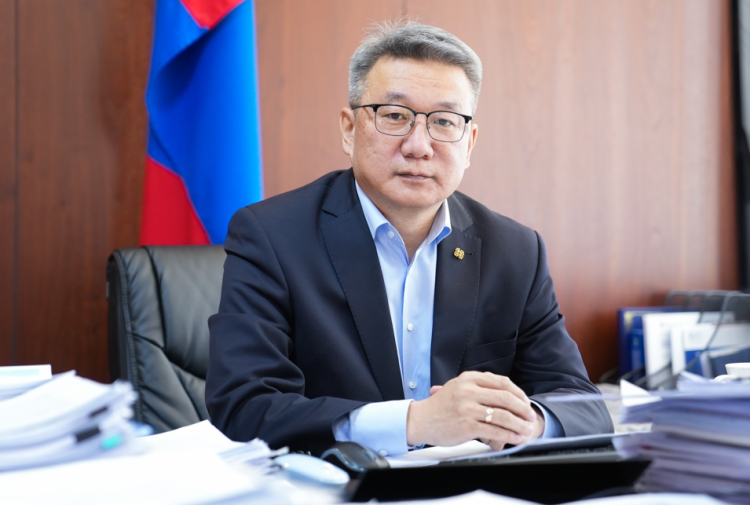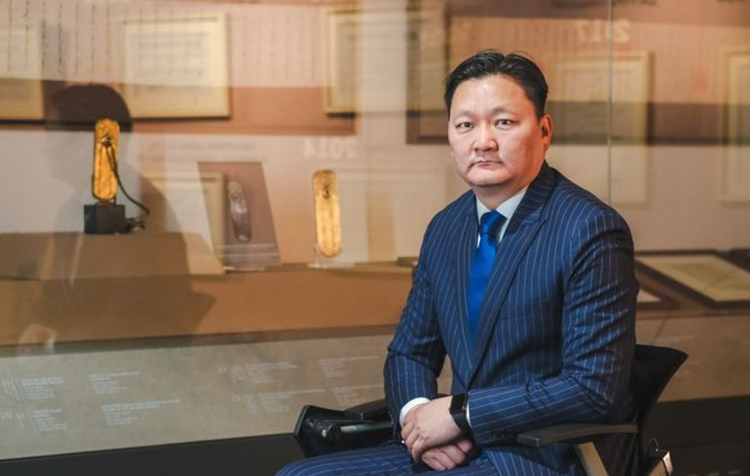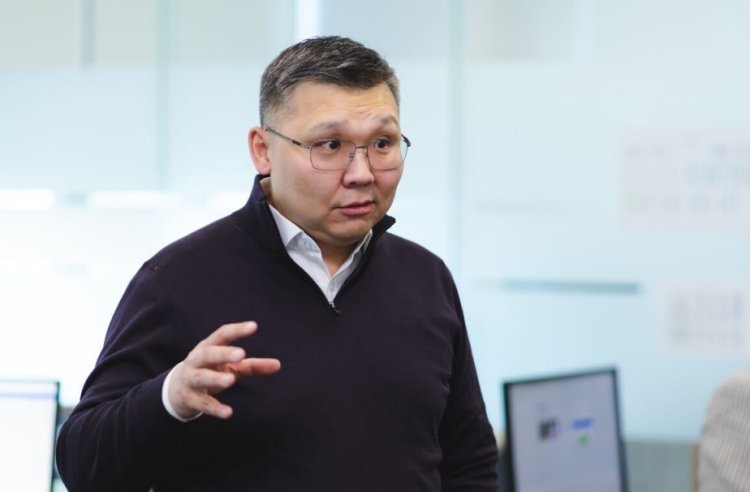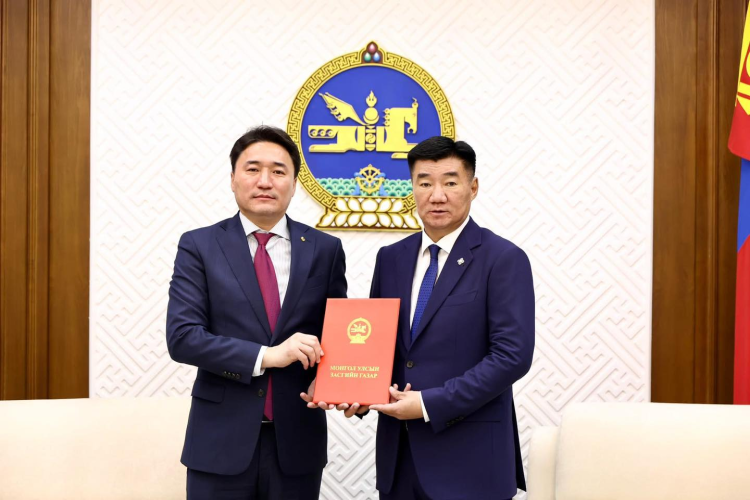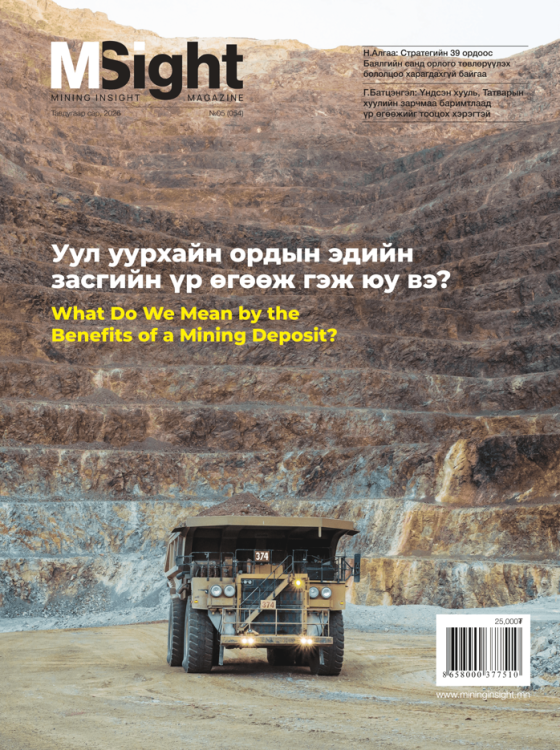


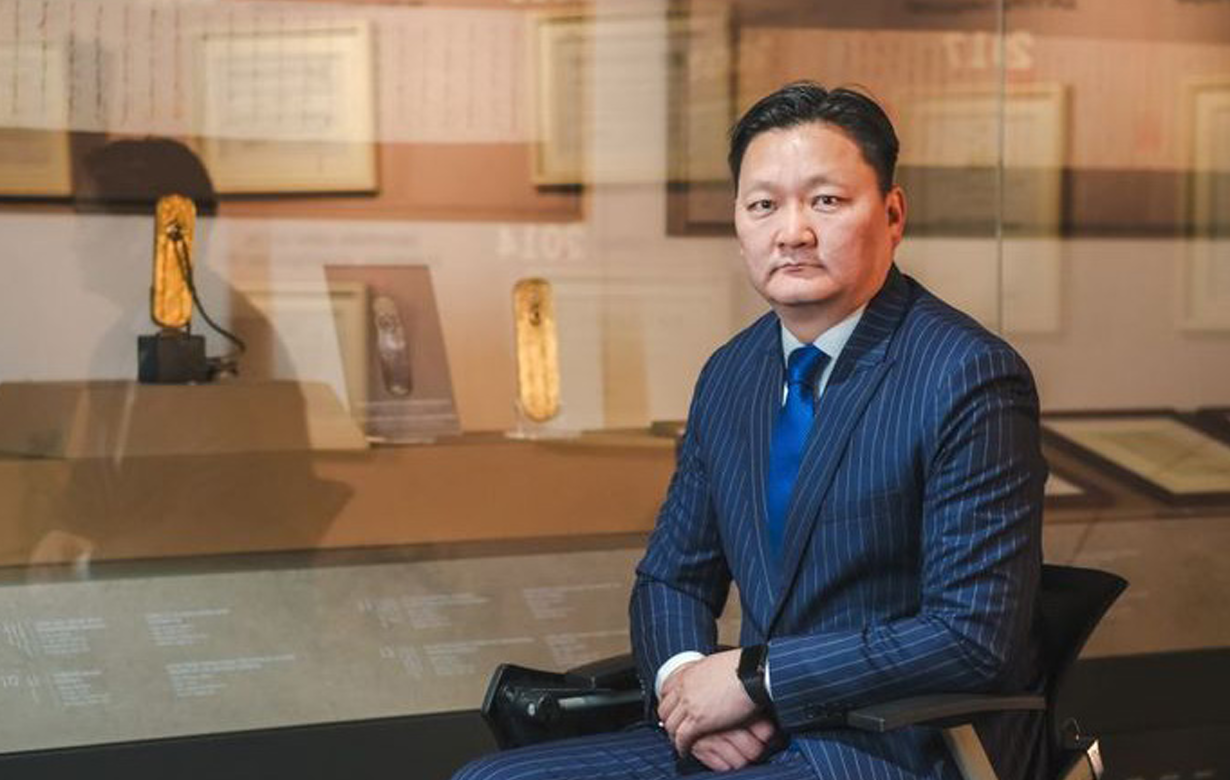
 Mining Insight’s N. Ariuntuya spoke with B. Davaadalai, Chief Advisor to the Prime Minister G. Zandanshatar and Head of the Prime Minister’s Office.
The Parliament has just approved Mongolia’s Five-Year Development Policy Directions for 2026–2030. What is the main objective of this national policy? How does this concept differ from the previous five-year plan, and what are the key reforms and priorities?
Mongolia’s Parliament has approved the country’s Five Year National Development Policy for 2026–2030. Under the Law on Development Policy and Planning, Mongolia now defines its national development priorities in five-year cycles, and the first full cycle concludes this year. The new five-year framework differs from the previous one in three major ways. First, it strengthens the alignment between the Government Action Plan, national budget, and policy documents. In the past, strategy tended to move in one direction while the budget moved in another, with annual budget revisions making policy appear unstable. The new approach mirrors international best practice: define the big picture first, then build calculations and budgets around it. This is the structural shift Mongolia aims to institutionalize. Second, the government has moved away from broad, vague, aspirational goals and adopted measurable, indicator-based planning. This results-oriented approach, similar to Estonia and South Korea’s planning models, clearly specifies who is responsible, what must be achieved, and how progress will be measured. For the first time, such a system is being fully introduced in Mongolia. Third, the framework prioritizes the core philosophy behind Prime Minister G. Zandanshatar’s “New Confidence, Bold Reform” agenda, which seeks to fundamentally reduce the economy’s vulnerability. A World Bank study shows that between 2004 and 2020, Mongolia earned USD 22 billion from mining, yet accumulated only around one percent of this amount in national savings. Most revenues were spent on social welfare, salaries, pensions, schools, kindergartens, and infrastructure. Given Mongolia’s vast territory and underdeveloped infrastructure, the need to build public facilities and maintain social spending is understandable. Coupled with politically driven expansions of welfare programs, the country now operates more than 70 social assistance schemes. This underlines the urgent need to increase national savings. Today, every downturn in commodity prices affects not only the national economy and budget but also household incomes, exposing the deep structural vulnerability created by dependence on volatile resource cycles. After COVID-19, Mongolia’s economy rebounded primarily because global commodity prices rose. But this growth was always expected to be temporary. The real question is whether Mongolia managed its revenues wisely during the boom: Did it save enough? Was it prepared for the inevitable decline? When coal prices began falling late last year, the tugrik weakened toward 4,000 per USD, foreign reserves shrank, and the budget faced a potential 3-trillion-tugrik shortfall. These events underscored how fragile the economy remains when tethered to commodity cycles. This is why the government believes the country must avoid repeating such volatility, learn from past mistakes, and spend income more responsibly. The essence of the Prime Minister’s “New Confidence, Bold Reform” message is exactly that. Resource-rich economies often face a familiar problem: sudden windfalls create incentives for rent-seeking and political capture. Mongolia is no exception. Even when revenues grow, money leaks through fiscal and governance “cracks” in the system. To fix these cracks, the government aims to tackle resource theft and corruption not just through enforcement but at the structural level. To support this agenda, the next five years of policy will focus on five priority areas: governance reform; human development (education, health, housing); digital transformation; energy; and environmental and green development. In essence, human development, reform of state-owned enterprises, civil service modernization, green policy, and energy security will form the backbone of development strategy for the next five years.
What concrete changes does the Government aim to deliver in these five priority areas?
First, in order to meaningfully address corruption, bureaucracy and the misuse of public resources, the Government believes there is no alternative to reforming state-owned enterprises (SOEs). Mongolia currently has more than 1,000 SOEs, most of which operate at a loss, suffer from weak governance and provide limited efficiency. International practice shows that improving SOE governance, privatizing non essential entities, and bringing idle assets back into economic circulation are common and effective reform strategies. Kazakhstan, for instance, privatized 65 companies under the “Samruk-Kazyna” fund in 2015 and streamlined loss-making entities, resulting in a 2.5-fold increase in efficiency. Georgia consolidated more than 900 state entities and dissolved over 200 as part of its SOE reform, sharply reducing corruption levels. Mongolia, likewise, must privatize sectors where state ownership is unnecessary, while transforming a small number of strategic SOEs into profitable, transparent, investor-ready companies. Public policy ultimately depends on the capacity, integrity and productivity of those who implement it, making civil service reform indispensable. Despite perceptions, Mongolia’s civil service is not disproportionately large: of roughly 200,000 public servants, nearly half are teachers and doctors providing essential services. The administrative civil service is comparatively small. Yet digitalization and structural reform are needed to optimize staffing and improve salaries. The Government plans to bring the ratio of civil servants per 100 citizens to an efficient level and raise salaries under a “fewer positions, higher pay” principle intended to improve performance and restore public trust. Second, Mongolia possesses significant competitive strengths most notably, a globally capable new generation achieving success across multiple fields. Human capital is the country’s most valuable resource. The Government therefore aims to channel resource revenues into human development with measurable impact. Past administrations were frequently criticized for prioritizing large-scale projects with limited benefit for everyday citizens. This time, Prime Minister G. Zandanshatar has made human development the central focus for the next five years, identifying three urgent priorities: education, health and housing. Education reform is essential to avoid falling behind in a rapidly changing world. Artificial intelligence is reshaping global education systems. China now teaches AI fundamentals from first grade. Singapore has fully embraced a skills-first model that adapts learning to each student’s strengths. Finland’s nationwide adoption of project-based learning has reduced learning gaps by 80 percent. Mongolia will move to modernize curricula, teaching methods and teacher development systems to align with these global trends. Housing is seen as a practical engine for strengthening the middle class. Although citizens have grown accustomed to the 6 percent mortgage program, its funding is unstable, and waiting lists now stretch two to three years. The reform agenda includes creating a housing bank, mobilizing domestic and green finance, and diversifying mortgage products. Targeted support will be offered to young families and large households. Chile’s green mortgage scheme, which provides interest rebates for energy-efficient homes, successfully boosted both demand and supply. Turkey’s decade-long TOKI program provided housing for 1.3 million families. Mongolia aims to double housing supply in the coming years Third, digitalization remains the most effective way to eliminate corruption at its roots. Wherever customs, tax administration or licensing processes involve human discretion, opportunities for graft persist. The Government plans to remove human involvement from public services entirely and shift to a fully digital, AI-driven, zero-contact service model. All 900 public services are expected to operate without human interaction. Fourth, energy. In the 21st century, energy shortages are a major constraint on development. Mongolia must increase its baseload capacity while attracting investment in renewable energy. Kazakhstan partnered with ACWA Power to build a 1.5 GW wind-solar park, securing USD 2 billion in investment. Uzbekistan expanded its renewable capacity twentyfold in just five years. Morocco’s Noor solar project dramatically reduced the country’s energy dependence. Mongolia aims to draw foreign investment into green energy, reduce its vulnerability and eventually enter the export market. Fifth, environmental sustainability will shape policy across all sectors. 77 percent of Mongolia’s territory is affected by desertification and half of that area is severely degraded. Droughts and zuds are becoming more frequent, and water resources are under strain, turning environmental degradation into a national security concern. The Government intends to deliver tangible results under the Billion Trees campaign, increase forest cover from 8 to 9 percent and update water resource and pastureland policies. Global examples such as Saudi Arabia’s Green Middle East initiative, China’s Great Green Wall and Israel’s water management reforms show that even severe environmental challenges can be addressed with the right policies and financing. Mongolia’s hosting of COP17 next year offers a major opportunity to attract international climate finance.
Is this set of five priorities simply a list of projects and programs, or is it a policy framework? And if it is a list, how does it differ from the Government’s Action Plan?
In reality, these five areas are not a list of projects the Government intends to implement. Rather, they represent Mongolia’s strategic direction and policy-level priorities for the next five years. In this sense, they differ from the Government’s Action Plan in several fundamental ways. First, national development policy documents follow a clear hierarchy and logical structure. Earlier this year, Mongolia approved its three-year medium-term budget framework in May, but when the annual budget was adopted in August, the earlier framework was revised raising public concern about policy inconsistency. In principle, the correct sequence is this: adopt the five-year development direction first, establish the big picture, and then align annual budgets, sectoral programs and ministry-level implementation plans accordingly. This is the foundation of a coherent policymaking system. Second, the five-year framework is a strategic policy document. It answers the question “What should be done?” at the national level. The Government’s Action Plan, on the other hand, answers “How will it be done? With which projects, within what timeframe, and according to which indicators?” The two operate on entirely different levels, one sets policy, the other sets implementation. The five-year framework defines the overarching vision, priority directions, key performance indicators and policy boundaries. It does not list specific projects or action items. Third, the five-year framework is adopted by Parliament, which gives it the weight of a quasi-legislative document. It becomes a binding policy reference that all ministries and agencies must follow. The Government’s Action Plan, by contrast, is not a law it is an implementation roadmap for the executive branch. In other words, the five-year framework establishes the strategic mandate, while projects and programs represent the tools through which that mandate will be carried out. For these reasons, Mongolia’s five-year development direction is not a catalog of projects. It is the country’s unified development strategy and guiding policy compass. The Government, ministries and agencies must design their implementation plans and budgets in alignment with this strategic direction.
Within the overall concept of the Five-Year Development Framework, what is the expected pace of economic expansion? Specifically, what is the GDP projected to reach?
Over the next five years, Mongolia’s economy is projected to grow by an average of around 6 percent annually. If GDP is estimated at roughly MNT 90 trillion this year, then with steady 6 percent growth, it is expected to exceed MNT 100 trillion next year, and reach approximately MNT 150–160 trillion by the end of the five-year period. To put this into context, GDP stood at just MNT 40 trillion in 2022. The sharp expansion of the past three years was driven primarily by surging coal export volumes and prices. In the post-COVID recovery, China implemented economic stimulus measures that boosted demand, allowing Mongolia to sell coal in record quantities and under far more favorable conditions. As a result, the economy appeared to expand rapidly within a short period though it is important to recognize that this growth was cyclical, driven largely by coal exports. The goal for the next five years is to shift away from this cycle-dependent pattern and build stable, diversified, multi pillar growth. Short-term gains from mining must be paired with reforms, productivity improvements, and higher-quality investment policies these are the foundations of long-term, sustainable economic development.
What policy direction will the Government pursue in the extractive sector? How is the medium-term development trajectory of the industry being defined?
First, based on global market trends and especially China’s policy outlook, coal demand is expected to remain relatively strong through 2030. After that, China plans to gradually restrict and phase down coal consumption. This means Mongolia’s coal export opportunities will remain open over the next five years, although prices are unlikely to rise sharply. Current projections estimate that coal will trade at a steady average of around USD 80 per tonne. Second, the most promising avenue for the sector’s future growth is to reinvigorate exploration. Without expanding Mongolia’s proven mineral reserves, the foundation for long term growth and revenue will narrow. To address this, the Ministry of Industry and Mineral Resources is preparing reforms to improve the investment climate, strengthen the legal framework, and make geological data more transparent. International examples demonstrate the importance of such reforms: Australia increased exploration investment significantly by adopting open geological data policies, while Kazakhstan attracted major global players through licensing reforms. Third, the Government will implement comprehensive reform of SOEs. The central goal is to establish transparent, publicly accountable governance. Erdenes Tavan Tolgoi will be transformed into a publicly listed company within five years. An international audit is now underway, and depending on the results, 10 to 20 percent of the company may be offered through the stock exchange by the first half of 2027. The structure of the more than 30 companies under the Erdenes Mongol holding is also being reassessed, with decisive measures planned for loss making entities. A major priority is the transition to fully digital procurement. The e procurement model piloted at Erdenet Mining Corporation is expected to be introduced at three to four major SOEs by 2026. Fourth, the Government is pursuing investment in strategic raw materials, particularly rare earth elements. With global supply chains seeking diversification, Mongolia is well positioned to take advantage of this moment. Countries such as Australia, the United States and Japan are actively supporting efforts to broaden rare earth supply sources, creating an opportunity for Mongolia to emerge as a reliable supplier.
Prime Minister G. Zandanshatar has stated that he will take a firm stand against resource theft and coal theft. What concrete solutions exist at the policy level?
The policy response is not a one-time action, but a comprehensive systemic reform. First, the most effective way to eradicate resource theft at its root is to transform SOEs into transparent, accountable entities with meaningful public participation. Even if law enforcement agencies prosecute individual cases, the problem will continue to recur unless the system itself changes. For this reason, the core policy direction is to insulate these companies from political influence, make management appointments and decisions transparent, strengthen public oversight, and fully digitalize procurement, contracts, and decision-making processes. Second, the Government is focusing on bringing the Borteeg deposit into economic circulation through an open and competitive model. A public tender will be announced, and cooperation will be established with the investor offering the highest economic return. There are numerous international examples of transparent, contract-based partnerships in resource development. In Kazakhstan, for instance, opening certain deposits to competitive tendering increased investor competition and significantly improved transparency. Third, it is essential to bring clarity and final resolution to specific cases related to resource theft and to uphold the public’s right to information. While investigations and oversight processes naturally require time, allowing cases to drag on creates a perception of uncertainty, where individuals appear neither guilty nor innocent. This undermines public trust in the state. Therefore, it is important to disclose the progress of each case transparently, improve coordination among investigative bodies, limit political interference, and ensure that concrete cases are resolved fully and conclusively.
Will additional SOEs be established? Since the adoption of the Sovereign Wealth Fund Law, there has been a growing perception, particularly under the previous government, that economically significant deposits would be taken over by the state. Will this policy continue?
The Government’s policy is to avoid expanding the state structure as much as possible and not to establish large numbers of new SOEs. The implementation of the Sovereign Wealth Fund Law is not aimed at having the state take ownership of all deposits, but rather at creating a fair and balanced framework for cooperation between the state and the private sector. At present, negotiations are ongoing regarding three derivative deposits associated with the Erdenet tailings, discussions that began under the previous government. According to the working group, these issues are expected to be resolved in the near term. There is no need to establish new companies, as management and ownership can be exercised through shareholding within the Erdenes Mongol holding structure. Under the Sovereign Wealth Fund Law, state ownership arrangements are clearly defined under two main conditions. First, for deposits explored using public funds, the state has the right to own up to 50 percent of the company operating the deposit. This is based on the principle that when taxpayers finance exploration and resource definition, it is appropriate for the state to retain a meaningful ownership stake. Second, for deposits explored using private capital, where the private sector has borne all the risks, the state may acquire a stake equivalent to up to 34 percent of the invested capital. This mechanism has been accepted by the private sector, and negotiations are proceeding in an open manner. In other words, the state does not intend to forcibly take over all deposits. Instead, it seeks to apply a balanced ownership model that takes into account the investment structure, risk allocation, and expected returns. With regard to relations with the private sector, since the formation of the new government, two rounds of meetings have already been held with several companies that hold strategic deposits. Because each deposit requires a detailed assessment of its valuation, investment history, and resource definition, this process will inevitably take time. The Government intends to act swiftly and in an organized manner to arrive at solutions that balance the interests of all parties. This is not a policy of expanding state power, but one aimed at establishing a sustainable and fair model for resource development. International experience points in a similar direction. Kazakhstan maintains a 50 percent state participation in strategic deposits, but instead of creating additional SOEs, it consolidated assets under the Samruk-Kazyna holding to improve governance efficiency. Norway manages state participation in resource projects through Equinor, without creating new companies, working in partnership with the private sector on investment decisions. Chile retains state stakes in strategic deposits as well, but rather than forming new SOEs, it has consistently strengthened the structure of Codelco. Mongolia’s approach follows the same logic: reinforcing a leading national holding, improving governance, and partnering fairly with the private sector, rather than creating numerous new SOEs.
During meetings with companies holding strategic deposits, the Prime Minister introduced the idea of consolidating existing taxes into a unified Wealth Tax system. What does the term “50+1 percent Wealth Tax” mean? Does it imply the creation of a new tax, or an internal adjustment of existing taxes? Have analyses, studies, or methodologies been conducted, or are they planned?
The Prime Minister’s reference to a “50+1 percent unified Wealth Tax system” does not imply the creation of a new tax. Rather, it is an initiative aimed at bringing coherence and clarity to Mongolia’s currently fragmented mining tax system by aligning it under a single framework and shared logic. First, no new tax will be introduced. Existing taxes such as corporate income tax, value added tax, VAT deductions, mineral royalties, social insurance, and allocations to local development funds are currently disconnected and difficult for the public to understand. The proposal is to consolidate these flows into a single, transparent and purpose driven structure. The 50+1 percent principle refers to clearly defining how the total stream of taxes and payments generated by mining is distributed among the state, local governments, and citizens, and making visible where company payments go and through which channels. The objective is to address the long-standing public perception that mining revenues disappear into opaque systems. Second, the aim of this initiative is not to increase taxes, but to make the existing system more transparent and understandable. Public criticism often centers on the belief that mining generates large revenues that do not reach ordinary citizens. In reality, companies do pay taxes, and in some cases also make additional local level contributions. The core problem is that it is not clear how much value a specific company delivers to a specific locality, or through which mechanisms those benefits reach local residents. The proposed system seeks to uphold citizens’ right to information, clearly demonstrate how private sector tax payments translate into tangible public benefits, and build trust without increasing the overall tax burden. Third, there is a need to address significant disparities in returns from major projects. For example, Erdenet Mining Corporation, despite having smaller reserves and capacity than Oyu Tolgoi, contributes more revenue to the state budget on an annual basis. Oyu Tolgoi, by contrast, operates under a stabilization agreement, resulting in comparatively lower tax contributions in the near term. The discussion therefore focuses on improving alignment and fairness across projects with markedly different fiscal outcomes. This is not about raising taxes, but about improving policy coherence and methodology. Work is already underway at a professional level on the design and methodology of the unified tax system. Further steps will include developing a consolidated tax matrix, revenue distribution models, and clear frameworks showing how revenues flow between the national budget, local governments, and citizens. International experience offers relevant examples. Norway manages all petroleum related taxes through a unified revenue basket and reports them transparently to the public. Chile consolidated its copper tax system into a single framework, which helped reduce corruption and public mistrust. Kazakhstan began implementing a Unified Tax Model in 2022, bringing together mining taxes, royalties, and local payments. Mongolia’s objective is aligned with these best practices: not to increase taxes, but to strengthen transparency, trust, and fair competition through a clearer and more coherent system.
The Prime Minister has suggested that instead of keeping the Future Heritage Fund invested abroad at a 3 percent return, part of its resources should be linked to addressing urgent social challenges such as housing and air pollution. What is the economic rationale behind this idea, and how sustainable is it in the long-term?
The Prime Minister’s view that the Future Heritage Fund should not be left entirely invested abroad at a 3–4 percent return, but rather partially aligned with urgent domestic priorities such as housing and air pollution, is grounded in a clear economic logic. First, Mongolia’s primary source of income remains the mining sector, and achieving tangible progress in the short term requires access to large scale financial resources. While sectors such as agriculture and manufacturing are essential for diversification, their growth will yield results only after five to ten years. By contrast, today’s challenges related to housing shortages, air pollution, and livelihoods are immediate and demand substantial upfront investment. Second, more than USD 1 billion accumulated in the Future Heritage Fund is currently placed abroad with an annual return of 3–4 percent. At the same time, Mongolia is borrowing externally at interest rates of up to 10 percent to finance domestic investment needs. From an economic perspective, this represents a lost opportunity for growth. With sound management, allocating a defined portion of the Fund to high impact domestic social projects could, over the long term, increase the Fund’s overall return while also delivering broader economic and social benefits. Third, international practice generally favors investing sovereign wealth funds abroad. However, countries that follow this model, such as Norway and Chile, have already resolved their core issues related to housing, infrastructure, and air quality. In Mongolia’s case, these foundational challenges remain unresolved. The Prime Minister’s point is that maintaining low yield external investments while major domestic bottlenecks persist effectively limits the country’s development potential. There are relevant international examples. Singapore’s Temasek model allocates a portion of its assets to strategically important domestic projects in housing, infrastructure, and innovation, using rigorous risk management. This approach has accelerated national development, increased the fund’s own returns, and supported economic diversification. South Korea’s development finance model similarly directed part of its accumulated capital into housing, industrial capacity, and export related infrastructure, enabling the economy to achieve stable growth within a relatively short period.
The Prime Minister has issued an official directive calling for the disclosure of investment agreements related to strategic deposits, a review of expired contracts, and an assessment of so called “lost opportunities,” including whether the state’s ownership share should be reconsidered. What is the policy rationale behind this, and what criteria will guide decision making?
The core policy rationale behind the Prime Minister’s directive to make investment agreements for strategic deposits transparent and to reassess expired contracts with a focus on identifying “lost opportunities” is to ensure that the state learns from past experience and applies those lessons to secure fairer and more efficient agreements in the future. The underlying principle is straightforward. For each contract that has expired, a professional assessment will examine what opportunities existed at the time and whether the state failed to capture potential benefits. Where room for improvement is identified, the option of reopening negotiations and improving contractual terms will be explored. Where renegotiation is not feasible, the exercise will still serve an important purpose by generating long term institutional lessons, ensuring that similar mistakes are not repeated in future agreements. This approach is not intended to create new disputes. Rather, it reflects a policy choice to conduct a one-time, objective evaluation of past missed opportunities and to transform those findings into institutional knowledge that can inform future projects. International experience offers relevant parallels. Chile, for example, has applied a practice of reassessing copper contracts upon their expiration through economic rent analysis, calculating whether the state failed to capture an appropriate share of value. Based on these assessments, Chile adjusted tax, royalty, and participation models in subsequent contracts, increasing the state’s share of benefits by an estimated 10 to 15 percent in newer agreements. Kazakhstan provides another example. Beginning in 2015, the government reviewed 25 mining stabilization agreements and, as contracts expired, renegotiated and improved their terms where possible. As a resultof this systematic evaluation of previously missed opportunities, state revenues increased by several hundred million US dollars annually.
Thank you for the interview.
Mining Insight Magazine, November 2025